
The wali mujbir is a technical term of Islamic law which denotes the guardian of a bride. In traditional Islam, the literal definition of wali, which means "custodian" or "protector", is used. In this context, it is meant that the silence of the bride is considered consent. In most schools of Islamic law, only the father or the paternal grandfather of the bride can be wali mujbir.
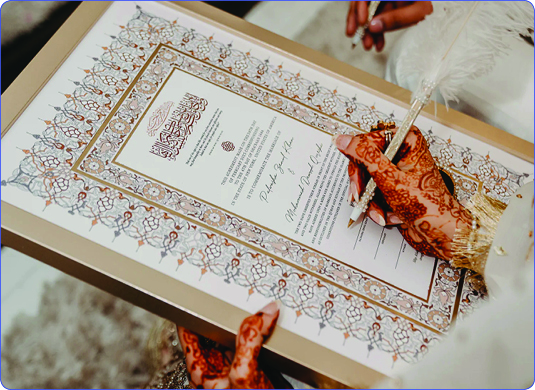
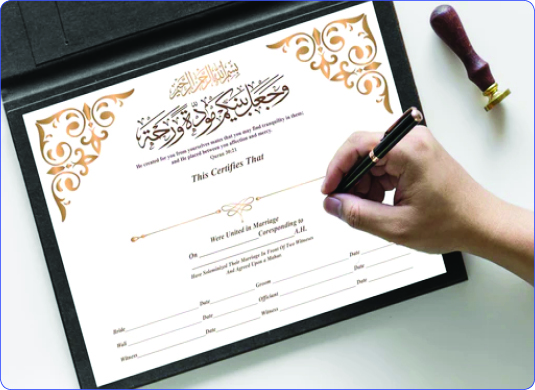
If the conditions are met and a mahr (dowry) and contract are agreed upon, an Islamic marriage ceremony, or wedding, can take place. The marital contract is also often signed by the bride. The consent of the bride is mandatory. The Islamic marriage is then declared publicly by a responsible person after delivering a sermon to counsel and guide the couple. It is not required, though customary, that the person marrying the couple should be religiously well-founded in knowledge. The bridegroom can deliver the sermon himself in the presence of representatives of both sides if he is religiously educated, as the story goes about Imam Muhammad bin Ali around 829 AD. It is typically followed by a celebratory reception in line with the couple's or local customs, which could either last a couple of hours or precede the wedding and conclude several days after the ceremony.
Prerequisites
There are several conditions for an Islamic marriage to take place:
- A marriage should be conducted through a contract and a mandatory sum of wealth provided to the bride, which here refers to the mahr (dowry). Once a mahr has been ascertained with the realization that it is an obligation of a Muslim husband, the groom is required to pay it to the bride at the time of marriage unless he and his bride can mutually agree to delay the time of some of its payment. In 2003, Rubya Mehdi published an article in which the culture of mahr among Muslims was thoroughly reviewed. There is no concept of dowry as such in Islam. A dowry as such is a payment to the groom from the bride's family and is not an Islamic custom. Bride prices are also expressly prohibited.
- Another requisite of marriage is chastity. No fornicator has the right to marry a chaste partner except if the two purify themselves of this sin by sincere repentance.
- Marriage is permitted for a man with a chaste woman either Muslim or from the People of the Book (Arabic Ahl al Kitab, Jews, Sabians and Christians) but not to polytheists or "idolaters". For women, marriage to People of the Book is not explicitly stated as permissible.
- Spoken consent of the woman is only required if she is not a virgin and her wali is neither her father nor her paternal grandfather. But a virgin may not be married off without her permission. If she is too shy to express her opinion her silence will be considered as implicit agreement [Al Bukhari:6968]. Binti Khudham says that when she became a widow her father solemnized her marriage. She did not like the decision so she went to Muhammad, who gave her permission to revoke her marriage. Hence, forced marriages are against Islamic teachings, and those forced into marriages before they have come of age have the right to contest them once they do.
- The importance of the wali is debated between the different schools of thought. To the Hanafi Sunnis, a male guardian is not required for the bride to become married, even if it is her first marriage. Therefore, the marriage contract is signed between the bride and the groom, not the groom and the wali. To the Hanbali, Shafi'i, and Maliki Sunni schools, a wali is required in order for a virginal woman to marry. In these schools, if a woman has been divorced, she becomes her own guardian and does not need a wali to sign a marriage contract.
Rights and obligations of spouses
According to Islam, both men and women have rights over each other when they enter into a marriage contract, with the husband serving as protector and supporter of the family most of the time, from his means. This guardianship has two aspects for both partners.
According to one interpretation, the husband must be financially responsible for the welfare and maintenance of his wife or wives and any children they produce, to include at a minimum, providing a home, food, and clothing. In return, it is the duty of the wife to safeguard the husband's possessions and protect how wealth is spent. If the wife has wealth in her own capacity she is not obliged to spend it upon the husband or children, as she can own property and assets in her own right, so the husband has no right for her property and assets except by her wishes. A pre-marital agreement of the financial expectation from the husband is in the mahr, given by him to the wife for her exclusive use, which is included as part of his financial responsibility.